

Why 30mm Cobbles Perform Better Than 20mm Cobbles
When selecting natural stone cobblestones, one of the most overlooked details is thickness.
At first glance, 20mm and 30mm cobbles may appear relatively similar.
But from a performance perspective, the difference can be significant — particularly in trafficable and long-term applications.
At AUSSIETECTURE, we regularly recommend 30mm cobblestones for projects where durability, structural stability, and long-term performance matter most.
Because while thinner cobbles may reduce upfront costs, thicker cobbles often deliver far superior outcomes over time.
Thickness Directly Affects Strength
The most obvious advantage of 30mm cobbles is: greater structural strength.
Thicker stone generally provides:
- higher load capacity,
- improved impact resistance,
- and better stress distribution.
This becomes particularly important in areas exposed to:
- vehicle traffic,
- heavy foot traffic,
- turning vehicles,
- commercial use,
- and driveway applications.
While 20mm cobbles may suit lighter pedestrian areas, 30mm cobbles typically offer a much greater margin of long-term durability.
30mm Cobblestones Better Handle Vehicle Traffic
Vehicle loads place enormous stress on paving systems.
Pressure from:
- tyres,
- turning movements,
- braking,
- and repeated loading
can eventually weaken thinner paving materials over time.
30mm cobblestone generally perform better because the increased thickness helps:
- distribute loads more effectively,
- resist cracking,
- and reduce long-term movement risk.
This is one reason many architects and landscapers favour 30mm cobbles for:
- driveways,
- porte-cochères,
- courtyards,
- and trafficable paving areas.
Thicker Cobblestones Create Greater Stability
Natural stone paving systems are constantly exposed to:
- movement,
- moisture,
- thermal expansion,
- and settlement.
30mm cobbles naturally possess:
- more mass,
- greater rigidity,
- and improved stability
compared to thinner 20mm profiles.
This additional stability can help reduce:
- rocking,
- movement,
- edge failures,
- and long-term paving deformation.
Better Architectural Depth and Shadow
Performance is not the only advantage.
30mm cobbles also tend to create:
- deeper shadow lines,
- richer texture,
- and a more substantial appearance.
This additional depth helps cobblestone paving feel:
- more authentic,
- more grounded,
- and more architecturally refined.
Thicker cobbles often better replicate the timeless character associated with traditional European stone paving.
In luxury architecture especially, this added depth can significantly elevate the visual outcome.
30mm Cobblestones Feel More Substantial Underfoot
There is also a tactile difference.
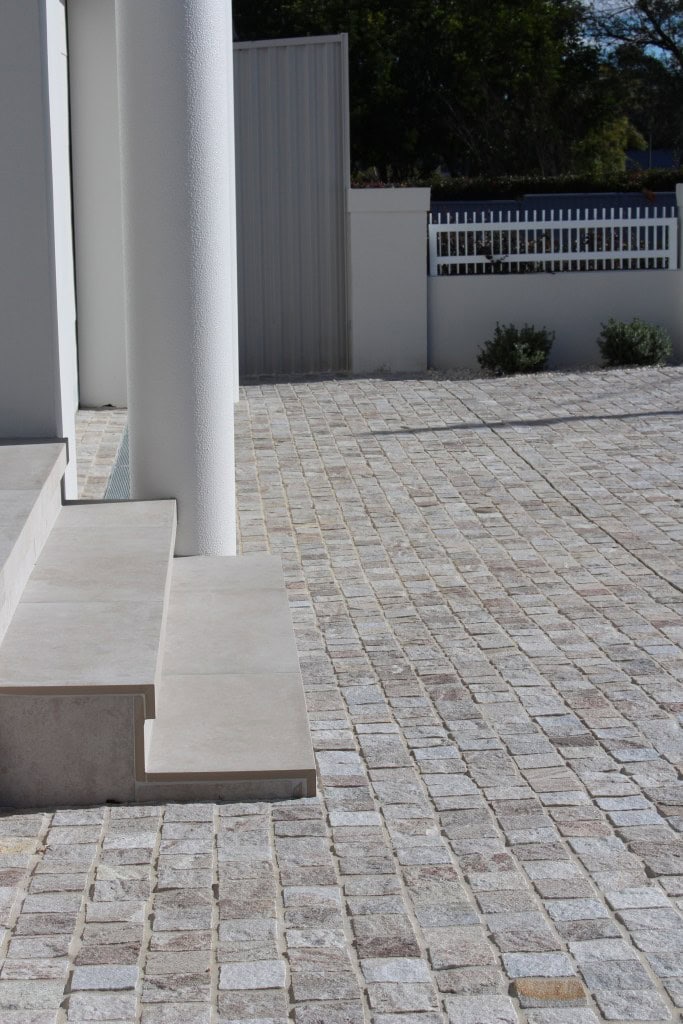
Thicker cobbles often feel:
- firmer,
- more solid,
- and more permanent
under both foot traffic and vehicles.
This contributes to the overall perception of quality within the project.
Natural stone is often selected specifically because it introduces:
- permanence,
- weight,
- and material authenticity.
Thicker cobbles reinforce this feeling.
Edge Durability Improves With Thickness
One common issue with thinner paving systems is edge vulnerability.
Repeated loading and movement can place stress on:
- corners,
- edges,
- and joint transitions.
30mm cobbles generally offer:
- stronger edges,
- improved resilience,
- and reduced chipping risk
compared to thinner profiles.
This becomes especially important in:
- driveways,
- commercial paving,
- and high-use areas.
Installation Tolerances Are Often More Forgiving
Natural stone installations are never perfectly static.
Minor substrate movement, bedding variation, and long-term settlement can occur over time.
30mm cobbles tend to be:
- more forgiving,
- more stable,
- and less susceptible to flex-related issues
than thinner stone systems.
This can help improve long-term paving integrity.
Thin Cobblestones Are Not Always Cheaper Long-Term
20mm cobbles may initially appear more economical due to:
- lower material usage,
- lighter freight,
- and reduced handling weight.
But if thinner cobbles eventually contribute to:
- cracking,
- movement,
- replacements,
- or shorter lifespan,
the long-term cost advantage can disappear quickly.
Stone paving should always be viewed as a long-term architectural investment — not simply a short-term material purchase.
The Substrate Still Matters
Even the best cobbles can fail over poor foundations.
Regardless of thickness, successful cobblestone performance still depends heavily on:
- proper excavation,
- compaction,
- drainage,
- bedding preparation,
- and installation quality.
However, thicker cobbles generally provide a stronger paving system once installed correctly.


Different Applications Require Different Solutions
20mm cobbles still have legitimate uses.
They may be perfectly suitable for:
- pathways,
- decorative paving,
- low-traffic areas,
- and lighter pedestrian applications.
But for projects involving:
- driveways,
- commercial traffic,
- heavy landscaping,
- or long-term architectural durability,
30mm cobbles often provide significantly better performance and peace of mind.
Great Stone Paving Is About Longevity
At AUSSIETECTURE, we believe natural stone paving should not only look beautiful on completion day.
It should continue performing for decades.
That is why thickness matters.
Because while 20mm and 30mm cobbles may appear similar in a sample, the difference becomes far more noticeable over time — both structurally and architecturally.
And in many cases, the extra depth, durability, and permanence of 30mm cobbles make them the stronger long-term investment.
We would love to see you visit our stores.
Unit 25-26 / 85-115 Alfred Rd, Chipping Norton NSW 2170
5/7 Byres St, Newstead QLD 4006
Lot 92 Seventeen Mile Rd, Helidon QLD 4344
hi@aussietecture.com.au
Related Products

FLAMED

SPLIT

TUMBLED

TUMBLED